
Published Jan 31, 2026
Here’s a scene we can all recognize from the movies:
A well-heeled family gathers in the library of a formidable mansion. An attorney pulls a folder from his worn leather briefcase and clears his throat to start the proceedings. The family members lean forward, practically foaming at the mouth, anxious to learn their fate as the attorney reads the deceased patriarch’s last will and testament aloud. This scene defines winners and losers, and it kicks off 90 minutes of betrayal and intrigue.
It’s compelling. But like most things in the movies, it doesn’t happen in real life.
In real life, a will is important, but it’s not the master document people often assume it to be. It’s just one piece of the puzzle, and honestly? Kind of a boring one at that.
Let’s get into what a will does, what it doesn’t do, and why it’s important to have a more comprehensive estate plan.

A memorable scene from Knives Out
Misconception #1: “A will governs how ALL of my assets are distributed”
Many people assume that a will is the master plan for everything they own. In reality, a will only governs assets that pass through probate.
Probate is the legal process through which certain assets are distributed after someone dies. It can take months or years. It can also be costly, thanks to court fees and attorney’s fees.
For these reasons, many people choose to structure their estate plans in such a way that most (if not all) of their assets are passed to heirs outside of probate.
Assets that typically go through probate:
- Real estate owned individually (not jointly, and not in a trust)
- Bank or investment accounts with no beneficiary designation
- Personal property
Assets that typically pass outside of probate:
- Retirement accounts with named beneficiaries
- Investment accounts with “transfer on death” or “payable on death” designations
- Life insurance policies
- Assets held in a trust
- Jointly owned property with rights of survivorship
Non-probate assets are transferred directly to the named beneficiary or beneficiaries, regardless of what the will says, and usually with minimal court involvement.
For someone who has done even basic estate planning, a significant portion of their assets will pass outside of probate. That means the instructions in the will may apply to only a small portion of the overall estate.
Misconception #2: “A will overrides everything else”
Even when people understand that some assets pass outside of probate, many still assume that the will has ultimate authority. It doesn’t.
If there is a conflict between what a will says and what a beneficiary designation or trust document says, the beneficiary designation or trust wins.
These designations are not suggestions. They are legally binding instructions that financial institutions are required to follow, regardless of what the will says. Probate courts do not “balance” asset distribution or try to infer intent across them.
This is where unintended outcomes can arise, not because anyone did something wrong, but because the different pieces of the estate plan were never aligned.
A case study
Let’s look at a simplified scenario.
Zoe has two children, Bobby and Annie. Zoe wants her assets to be split evenly between them when she dies, and she states this clearly in her will.
At the time of her death, Zoe has:
- A home worth $300,000 that she owns outright, to be sold after her death
- A retirement account worth $220,000, with Annie listed as the beneficiary
The total value of Zoe’s estate is $520,000.
Zoe may reasonably believe that by stating in her will that her estate should be divided equally, each child will ultimately receive $260,000.
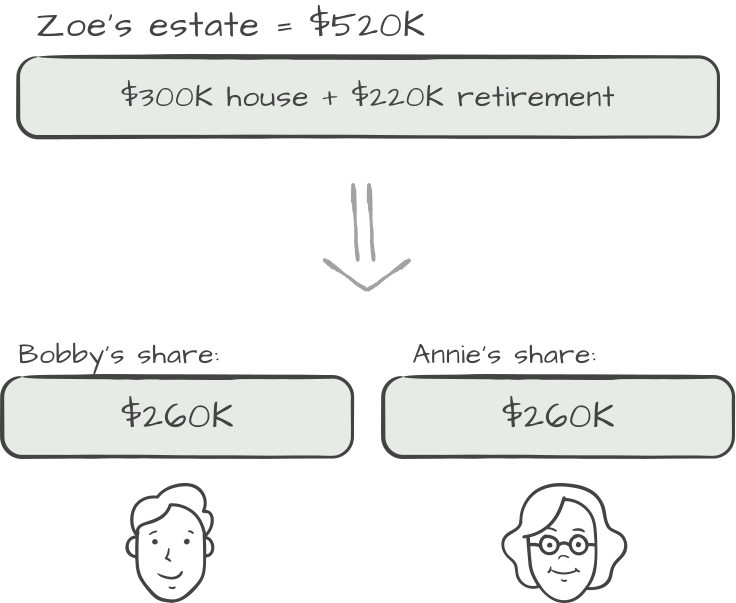
Here’s what actually happens.
The home is a probate asset and therefore governed by Zoe’s will. That proceeds from the sale of the house are split evenly, with each child receiving $150,000. The probate court will oversee this distribution.
Annie receives the entire $220,000 retirement account based on the beneficiary designation. The account passes to her directly, outside of probate.
When everything is settled, the totals look like this:
- Bobby receives $150,000
- Annie receives $370,000

Despite Zoe’s clear intention to divide her assets equally, Annie receives $220,000 more than Bobby. Her take is ~70% of the estate, while Bobby gets only ~30%.
Nothing improper happened. Both the will and the beneficiary designations were followed. And yet, the outcome is a far cry from what Zoe wanted.
Estate planning requires ongoing coordination and realignment
This kind of mismatch is common, especially when beneficiary designations haven’t been reviewed in years, or when accounts were opened at different points in life under different circumstances.
A will is an essential document. But it cannot do its job in isolation.
True estate planning requires coordination: between the will, beneficiary designations, account titles, and trusts. When those pieces aren’t aligned, the burden often falls on the people left behind to sort through the consequences. Not surprisingly, this can cause a lot of friction in even the most loving and functional families.
Understanding what a will is actually for and what it isn’t is one of the simplest ways to avoid unintended outcomes and to make things easier for the people who will one day be tasked with settling your affairs.
Icons by Drahomir Hajek, The Noun Project
Stay updated
If you’d like to receive updates on navigating grief, estate planning, and estate administration in your inbox, you can sign up for the Undermountain Partners newsletter here:
For informational purposes only; not legal or financial advice.