
Posted August 27, 2026
Hello, friends! I hope y’all are taking advantage of these last few weeks of summer before the leaves start to fall and the puffy coats come out of the closet.
This month, I’d like to focus on the complexity of settling an estate. Families often feel overwhelmed when faced with a murky but imposing set of administrative tasks after the loss of a loved one. And that’s a systemic failing, not a personal one. The deck is stacked—unintentionally, I believe—against the bereaved.
570 Hours of Hidden Work: What Families Face After a Loss
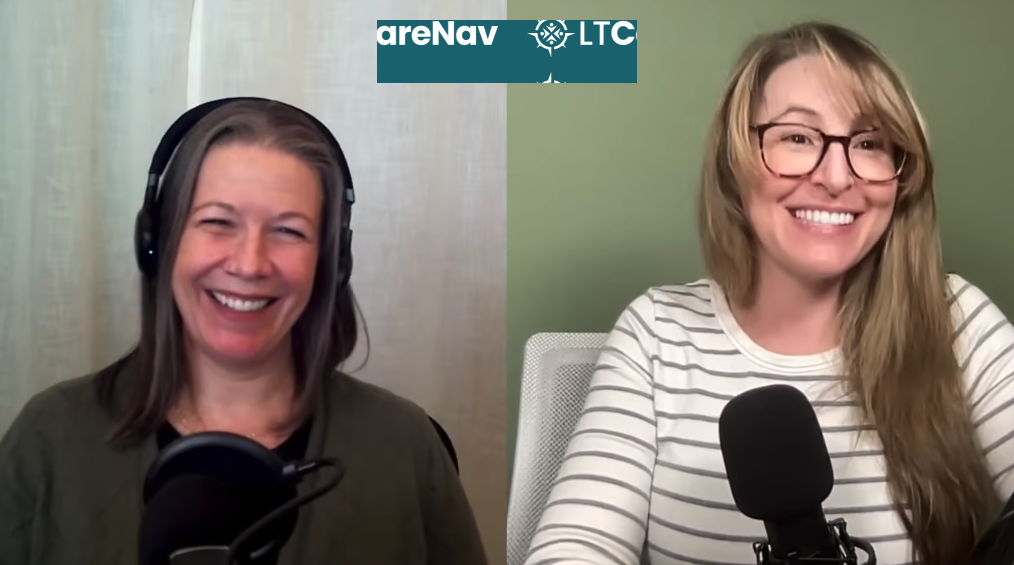
I recently chatted with LTCareNav’s brilliant founder, Lindsay Friedman, for her LTCareNav’s Care Compass podcast. Lindsay is a powerhouse entrepreneur and family caregiver who’s turned her attention to long-term care needs of the growing senior population.
In this podcast episode (YouTube, Spotify), Lindsay and I talked about the realities of settling a loved one’s affairs—the amount of work, the uniqueness of every after-loss project, grief brain, and the first thing a new executor should do.
If you or someone you know is navigating the labyrinth of long-term care planning, LTCareNav has many wonderful resources and tools! A few highlights:
- Care costs by state: https://ltcarenav.com/resources/care-costs-by-state
- Legal readiness quiz: https://ltcarenav.com/resources/legal-readiness
- Care cost and transition planner: https://ltcarenav.com/resources/home-care-vs-al-calculator
The Very Definition of a Complex Project
Settling a loved one's affairs isn't just paperwork. It's the very definition of a complex project to manage.
Folks who have never administered an estate may envision forms and paperwork: probate forms, funeral contracts, wills, and the inevitable visit to the DMV to retitle a vehicle.
And there is, indeed, paperwork.
But it's not JUST paperwork. We should be so lucky!
In reality, settling a loved one's affairs meets the criteria of a "complex project" as defined by the International Centre for Complex Project Management. In their terms, a complex project "involves a multitude of diverse, interconnected elements, including people, factors, and processes, which influence each other in ways that are challenging to predict, plan, model, and manage confidently."
Fortunately, just as corporations hire project managers, scrum masters, and TPMs to manage complex initiatives, busy and bereaved estate executors can get support from compassionate after-loss professionals!
Here are just some of the complex-project criteria estate administration meets:
- Interdependence: Executor, estate attorney, financial advisor, tax preparer, and family members mutually rely on each other to get to the end of the process.
- Dynamic evolution: Unknown assets and liabilities can emerge over time, changing tasks, processes, and roles.
- Non-linear relationships: Selling a house, resolving debts, filing taxes, and distributing assets may overlap, pause, or proceed in unexpected order.
- Uncertainty: The decisions of the court, an unpredictable family member’s behavior, or difficulty liquidating assets can significantly impact the process.
- Volatility: Grief and complex family dynamics can lead to dramatic fluctuations in the executor’s ability to follow through and make decisions.


But here’s the thing: when an organization takes on a complex project, many hands make light work. They have an expert—or more likely a team of experts—to dedicate full-time to the work.
Family executors usually are not experts, and they often have their own full-time jobs (+ families + a million other responsibilities) to manage.
If you or someone you know is struggling with the administrative demands after the loss of a loved one, they’re not alone, and support is available.
Stay updated
If you’d like to receive updates on getting your affairs in order, navigating grief, and estate administration in your inbox, you can sign up for the Undermountain Partners newsletter here:
For informational purposes only; not legal or financial advice.